25 Mar 2010

Online political communication: a war between the media and politicians?

Politicians can no longer ignore the power of online media. While some platforms - such as YouTube - are “an enduring source of embarrassment” for them, as Craig showed in “You Tube: Political Headache”, others are weapons of attack in an attempt to win electorate.


The Romanian presidential elections of last year were filled with examples of politicians using social and online media in the battle for winning the highest position in the state. They set up Twitter accounts and created blogs, websites and Facebook pages. I have to specify that youths are generally reached with these instruments in Romania in contrast with the UK where even elderly people know what a tweet is.

But since we are talking about wars between the media and politicians I will stop at two episodes from the elections series.

Traian Basescu versus the TV

The former and yet present president of Romania, Traian Basescu, has (like any other politician one may say) supporters and enemies. Among the most important enemies we find highly influential TV hosts Mircea Badea, Mihai Gadea and Valentin Stan (let’s call them ‘the three musketeers’). Under the slogan “Are you voting the TV?” Traian Basescu ran a campaign in November 2009 meant to show people that his statements are misinterpreted and negatively commented by the three, claiming voters should not let themselves influenced by the TV. The campaign benefited from a website (URL reading ‘television as president’) where parody videos involving the musketeers were uploaded (which of course highly circulated on the internet as well). The parody with Mircea Badea, presenter of “In gura presei” pamphlet press review show, depicted Train Basescu making the ‘simple’ statement “It is raining outside” and the musketeer negatively interpreting the sentence. The reply soon came and Mircea Badea reversed the script during a live TV show. In the new ‘play’ Badea asked Basescu questions regarding controversial topics implicating the president, who simply answered “It is raining outside”. The “war” was highly covered in Romanian media – online and offline. You can see all the videos here but unfortunately the recordings are in Romanian.

Social media is green...or maybe not

The Green Party entered the Romanian political scenery with the occasion of the 2009 presidential elections. They were “fresh” and so was the leader Remus Cernea. He gained electorate, especially teenagers, using social media. At one point, the party sent a press release announcing the green candidate leads the polls on the internet, being among the most covered politicians in the online medium. A journalist from “Academia Catavencu” pamphlet publication made fun of him saying he was good on the internet because he had nothing else to do all day given the fact that he lived with his parents. Email exchanges followed between the journalist and the campaign staff member (this was an indirect "war"). The editor at “Academia Catavencu” continued to make fun asking whether Remus Cernea had his own room in his parents’ house.

Given the above I must say that online political communication has both pros and cons. And the online media represents the battlefield between journalists/media representatives and politicians, politicians and politicians, politicians and enemies and so on.

Update: FYI - Remus Cernea is the first and only Romanian politician in the top 1000 politicians worldwide on Facebook in terms of number of fans, ranking 783 at the end of March (858 at the beginning of the month).

24 Mar 2010

Downsides of social media

People talk about the benefits social media brings to organizations. A recent study showed that consumers who are Facebook fans and Twitter followers of a brand not only recommend, but also buy the brands they tweet with or write wall comments to. Which means social media can trigger sales, among so many others.

I personally do not contest the advantages of engaging into social media. However I think PR professionals and companies should think twice before writing a blog, creating Facebook pages and tweeting with clients. And I am not the only one of course – PR Blogger and others also covered the issue.

What are the reasons I invoke?

First, online exposure can also have side effects. An organization present online is prone to receive negative comments, not only positive and neutral ones.

Second, once companies are online people have certain expectations from them. If an organization accustoms its clients to announce sales on Twitter it will have to “keep its promises” and send tweets no matter what. Or if a company creates a blog with interesting materials posted every day, it has to keep providing such information daily.

Third, with online media it is so much easier to lose control over the message. Links, photos, videos and so on travel with light speed from computer to computer. If a company issues wrong information the chances to correct it in time (before it is widely spread) are low. How could one make sure the correct version gets to all the people who have received the bad one? In contrast, with offline media a company gets the chance to present correct versions of a story in the next morning’s newspaper.

Forth, a promise is a promise. If a company is on social media it has to be there 24/7. That is why a lot of resources are engaged when jumping into this vast communication pool.

The best thing to do before engaging into social media is to make a thorough analysis (why not even a SWOT one?) to see how appropriate the approach is for the company (also given the stakeholders) and to determine the compatibility of business objectives with social media.

23 Mar 2010

Online customer and media relations

Online media provides opportunities for managing relations with various stakeholders, from customers and the media (the most common perhaps) to suppliers and authorities.

Social media is a great way to keep in touch with clients. As Clare wrote, Facebook and Twitter offer chances for airlines (and not only) to hear from customers. They facilitate two-way communication (so much desired in theory but not so much applied in practice, until now) instead of one-way flow. Whereas newsletters were a widespread practice to keep clients updated on news and special offers without receiving any feedback, with tweets customers can now learn about news and sales while also expressing their views on the subject.

British Airways uses online media for both client and media relations. The airline has two Twitter accounts to communicate with customers (one for the US and one for the UK), with over 35,000 followers (not a very high number but still). I will however not describe BA’s social media efforts but rather focus on their online media relations, particularly in Romania. Sending press releases, handling media inquiries and managing interviews via e-mail are part of the day-to-day job of any PR professional. But online press conferences are not…

British Airways was the first airline (and company) in Romania to organize an online press conference. Such approaches are not so unusual now, but they used to be in 2007. I find the concept appropriate given the fact that the press conference was announcing the launch of the ba.com portal in Romania.


The conference

The BA online conference had the parts of any regular press meeting: welcome message, CEO speech and Q&A session. The venue was however virtual. Instead of registering at the welcome desk, journalists received a user name and a password in order to log onto the portal especially created for the event. It comes as no surprise that the media kit was available in electronic format.

The results

It generated important coverage, reading on both the launch of the ba.com website and the online conference itself. Journalists were enthusiastic about the idea and considered it was an original one. According to them the online conference was time saving. It was also a great opportunity for media representatives to participate at the event, as it would have been otherwise impossible because of the busy schedule.

As technology is evolving, stakeholders relations are changing too. We have learned few of the benefits online media brings in the relation with the customers and the media. By mixing some elements of social media and online media relations we get a new type of press conference. I will write about it in a future post. Clue: it is blue :)

Picture: Qsrmagazine

22 Mar 2010

Pros and cons of using YouTube for uploading videos

In the video below I present the benefits as well as the disadvantages of uploading corporate videos on YouTube channels versus using company websites.


For more information check out http://www.helium.com/items/1092150-how-do-i-use-youtube

21 Mar 2010

Evaluating online PR

Evaluation of the PR activity has always been an issue. In the book Effective Media Relations published by the Chartered Institute for Public Relations, Anne Gregory (2000) draws attention to the two schools of thought regarding the assessment of the public relations efforts. The first claimed the results of PR were intangible and impossible to measure. The second believed PR can be measured and looked at the number of press cuttings. A variation on the second school was to measure the cost of advertising in the media.

In the last years offline PR has been evaluated based on the following criteria, among others (Wilcox, 2009):
• measurement of advertising value equivalency - based on the size and position of an article in a media outlet
• measurement of media impressions – number of people exposed to the article and the messages given by circulation or readership
• measurement of key messages – counting how many pre-established messages were actually included in the articles
• measurement of production - total number of generated articles in a given period and the number of publications reached
• measurement of editorial slant – analyzing tone of voice: positive, neutral or negative
• event attendance – number of people attending an event

Although these are still not totally satisfactory methods they have been doing their job so far.


But PR is now moving towards online and the evaluation methods have to do the same.

Blogs, Twitter, Facebook, YouTube are the most common social media and assessment of online PR can be done for each one separately, as presented below. I underline that both quantitative and qualitative evaluation can be made for social media.

Metrics for blog (one can use Google Analytics for blog metrics):
• no of visitors
• no of unique visitors
• page views
• bounce rate
• average time spent on blog
• no of comments
• no of followers
• no of track-backs to blog

Metrics for Twitter:
• no of followers
• influence of followers
• no of company/brand/etc mentions
• no of direct messages
• attitude of tweets: positive, negative, neutral
• no of re-tweets

Metrics for Facebook fan page:
• no of fans
• no of “likes”
• no of comments
• general tone of comments: positive, negative, neutral

Metrics for YouTube channel:
• no of channel views
• no of views for individual video
• no of comments
• type of comments: positive, negative, neutral
• subscribers to channel
• ratings

Websites are also used in online PR even though I think they are not so much of a novelty. :) I will however list some metrics for websites:
• no of visitors
• no of unique visitors
• page views
• bounce rate
• average time spent on website

Besides the above metrics, PR pros can also determine some “returns” as presented by Brian Solis. He wrote about four ways to assess social media efforts:
• return on participation – measuring the time spent for engaging in social media e.g conversations
• return on involvement – evaluating touchpoints
• return on attention –seize, hold and measure attention in terms of produced responses activities
• return on trust – measuring loyalty and referrals

The online Kit Kat Jesus campaign is a great example of a high return on participation, involvement and attention. :)

11 Mar 2010

Media monitoring shifts toward online


Having an online presence requires online skills. PR professionals master the art or learn about how to make bloggers write about the company they work for, how to communicate with clients using Twitter, how to use corporate YouTube channels, how to create successful Facebook fan pages and so on.

But with thousands of people engaging in the online medium monitoring what is being said about a company is an issue. While monitoring agencies can deal with both offline (TV, radio and press) and online monitoring there are some free tools PR pros can use for an in-house online monitoring. I will briefly present four of them which I find handy to some extent: Technorati, Twitter search, Google Alerts, and RSS.

Technorati – allows key word and tag search in sites, blogs, posts, and news while filtering can be made by fields (entertainment, business, sports, politics etc) or by authority! (influence in the blogosphere).

Twitter search
– specialist search engine for Twitter based on key words. The advanced search function allows search by words, people, places, dates, attitudes! and other.

Google Alerts – provides e-mail updates based on selected key words. User can choose from news, blogs, video, groups, and comprehensive (multiple sources) opting for frequency of updates (as it happens, once a day, once a week).

RSS – subscribers to RSS receive updated information on subjecst of interest under the form of the so-called feeds. RSS are available for websites, blog posts, comments, online publications etc.

By using these tools PR pros can have an idea about what is being blogged, tweeted and commented about a particular company, event, topic, person etc. Not only can they track references about a company but they can also monitor competitors and other industry-related subjects.

One can now easily say that “Monitoring has never been easier thanks to all these online tools.” This may not be necessarily true…Although some of the instruments provide web pages monitoring in many languages sometimes they fail to effectively show the expected results. For example Google Alerts set for Romanian language offers e-mail updates with stories published even years ago! Moreover, receiving and gathering all the online references about the topic of interest are just the first step. Companies need to allocate human resources to filter all the information (in order to eliminate “spam”) and organize it.

Bottom line – online monitoring tools are of great help but they do have some limitations.

Picture: Interactive Insights Group

5 Mar 2010

From press release to social media news release

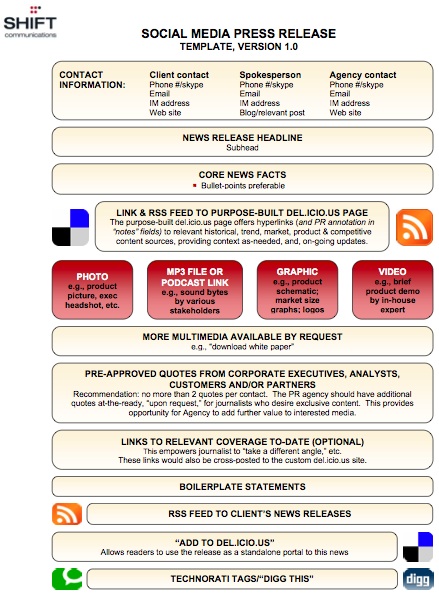
Technology has changed the way PR pros handle media relations. Some time ago press releases (PRS) were sent by mail. They have been distributed via e-mail in the last years. Technology is now evolving at fast speed and leaves its footprint on public relations practice once again. Here comes the social media news release (SMNR).

What is the difference between a press release and a social media news release?
ATTRACTIVENESS, STRUCTURE and REACH to name a few. Let’s have a look.

Features compared

While a SMNR includes the elements of a traditional PRS (logo, title, facts, quotes, boiler plate, and contact information) it also adds value to its receiver through multimedia, RSS, social bookmarking and other useful links – see the pictures below.


There are a few points I want to make about the comparison:
1. “A picture is worth a million words” and one can argue that traditional press releases can also include photos. I say that opening e-mail attachments takes longer than scrolling a mouse. :)
2. A SMNR is better structured than a PRS making it easier for readers/journalists to spot the information they need.
3. The format of SMNRs is attractive (take a quick look at two photos above!). First impression always counts even if we should not “judge a book by its cover”.
4. Sharing is facilitated through SMNRs (Copyblogger).

Receivers compared

With a SMNR public relations pros can directly reach media, consumers and other social media users (Davies, 2009) while with a traditional PRS only media is directly targeted - consumers are a second audience. Not only does a social media release have a better reach but it is also more effective because messages are not filtered by gatekeepers. Consumers actually get to be exposed to unedited messages!


Still, media is a common audience for both and when talking about gatekeepers one thing is for sure: if you want to make press or social media releases appealing to the media you must make them newsworthy. Some things never change, right? :) And if we are talking about PR and journalism it is worth mentioning that Contemporarypr blogged about the An Inconvenient PR Truth campaign run by Realwire against irrelevance of public relations materials which I find very interesting.

So which of the two should we use? One of my professors once said that the answer to any question is: “It depends.” I have to agree with him on this one. :) Two of the issues to be taken into consideration are company resources (financial, video, audio etc) and receivers’ characteristics (internet users or not).