Showing posts with label PR and technology. Show all posts

30 Mar 2010

Interpersonal needs theory applied in social networks in Romania

There is no doubt technology has changed the way we communicate, leaving its footprint on intrapersonal, interpersonal and group communication: from diaries we got to blogs, from letters we got to emails, from telephones we got to mobiles, from meetings we got to online conferences.

Defined, interpersonal communication takes place between two individuals (called a dyad) and has a number of determinants, among which the most important are age, gender, personality, education, occupation, social class and nationality (Rosengren, 2006). Several theories have tried to explain why people engage in communication with one other. Among these there is the interpersonal needs theory, according to which people engage in interpersonal communication to fulfill needs. Schutz (1958, cited in Sammut, 2010) suggests three such needs:

Inclusion – the need to establish identity with others;
Control – the need to exercise leadership and prove one’s abilities (applied in group communication as well);
Affection – the need to develop relationships with people.

Group communication takes place between more people who establish certain relationships among themselves. This type of communication is also influenced by certain variables, just like in the case of dyads.

With social networks interpersonal and group communications have moved online and the needs behind engaging into “relationships” (virtual ones) are changing.

A study conducted by Daedalus Millward Brown provides an insight on why Romanians use social networks like Twitter, Facebook and Hi5, explaining the needs behind engaging into virtual interpersonal and group communication in case of Romanian people (variable considered: nationality).

The results show Romanians use:

• Twitter for problem-solving, personal development, promoting opinions and ideas;
• Facebook for a sense of belonging, virtual entertainment;
• Hi5 for self-promotion.

I find interesting analyzing these findings and Schutz’s proposals from the perspective of Maslow's hierarchy of needs.


Whereas in Shutz’s view communication needs are more related to the love/belonging level of Maslow pyramid, in case of social networks and online communication needs are more focused on the esteem and self-actualization levels.

Given the fact that in Maslow's hierarchy needs are fulfilled on levels from bottom to top (which means people reaching esteem and self-actualization needs have already satisfied the love-related ones), we can conclude that with social networks people not only fulfill affection needs but go beyond them. Consequently, the highest peak in terms of satisfying personal needs can be reached with Twitter, Facebook and Hi5, at least in case of Romanians.

5 Mar 2010

From press release to social media news release

Technology has changed the way PR pros handle media relations. Some time ago press releases (PRS) were sent by mail. They have been distributed via e-mail in the last years. Technology is now evolving at fast speed and leaves its footprint on public relations practice once again. Here comes the social media news release (SMNR).

What is the difference between a press release and a social media news release?
ATTRACTIVENESS, STRUCTURE and REACH to name a few. Let’s have a look.

Features compared

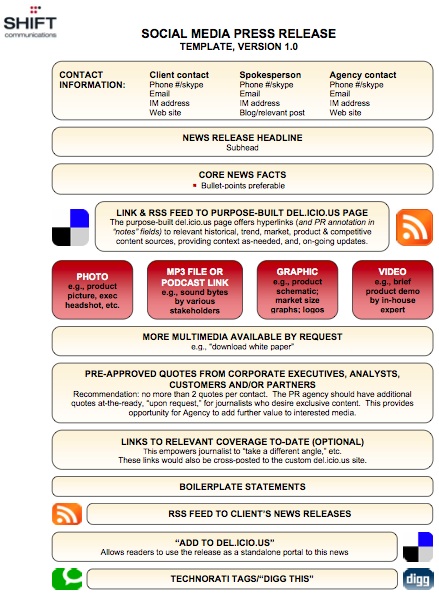
While a SMNR includes the elements of a traditional PRS (logo, title, facts, quotes, boiler plate, and contact information) it also adds value to its receiver through multimedia, RSS, social bookmarking and other useful links – see the pictures below.


There are a few points I want to make about the comparison:
1. “A picture is worth a million words” and one can argue that traditional press releases can also include photos. I say that opening e-mail attachments takes longer than scrolling a mouse. :)
2. A SMNR is better structured than a PRS making it easier for readers/journalists to spot the information they need.
3. The format of SMNRs is attractive (take a quick look at two photos above!). First impression always counts even if we should not “judge a book by its cover”.
4. Sharing is facilitated through SMNRs (Copyblogger).

Receivers compared

With a SMNR public relations pros can directly reach media, consumers and other social media users (Davies, 2009) while with a traditional PRS only media is directly targeted - consumers are a second audience. Not only does a social media release have a better reach but it is also more effective because messages are not filtered by gatekeepers. Consumers actually get to be exposed to unedited messages!


Still, media is a common audience for both and when talking about gatekeepers one thing is for sure: if you want to make press or social media releases appealing to the media you must make them newsworthy. Some things never change, right? :) And if we are talking about PR and journalism it is worth mentioning that Contemporarypr blogged about the An Inconvenient PR Truth campaign run by Realwire against irrelevance of public relations materials which I find very interesting.

So which of the two should we use? One of my professors once said that the answer to any question is: “It depends.” I have to agree with him on this one. :) Two of the issues to be taken into consideration are company resources (financial, video, audio etc) and receivers’ characteristics (internet users or not).

28 Feb 2010

Hello, everyone!


Welcome to my blog!

I am writing "Public relations under the sign of Technology" as part of the "PR and technology" module I am taking within the Master of Science in Public Relations Online at the University of Stirling.

From SMNRs to Twitter, from monitoring to strategy, from listening to sharing, this blog will be discussing issues related to technology and its influence on PR theory and practice.

Your feedback on my posts is very much welcomed and appreciated and I am looking forward to receiving your comments.

Until then enjoy the reading,
Ralu